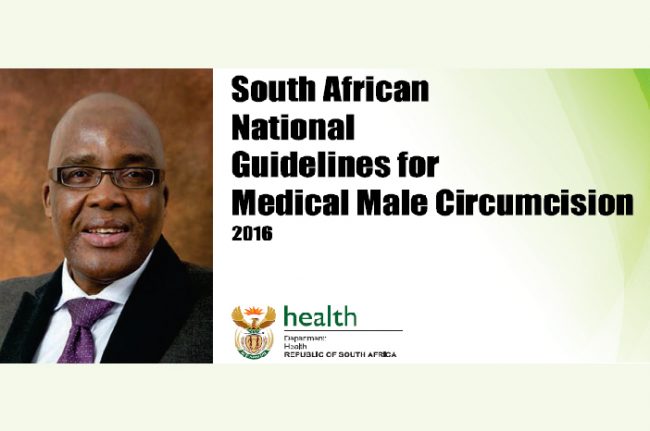
Message From Minister Of Health – Republic Of South Africa.

South Africa remains the country with the highest number of people living with HIV. The HSRC estimated that 6.8 million people were infected with HIV in 2014. Only 54% of them are aware of their HIV status. The epidemic has varied significantly across the nine different provinces in South Africa. Its diversity and the presence of concentrated epidemics within the generalised epidemic have played an important role in its spread and had an impact on its effective control.

There is sparse evidence to show that HIV prevention programmes have impacted significantly on HIV incidence. However medical male circumcision (MMC) has been shown in recent randomised clinical trials to provide around 60% reduction in the risk of HIV acquisition through heterosexual transmission in men. The results of these trials support the results of observational studies showing a strong correlation between high rates of male circumcision and lower rates of HIV prevalence.

Furthermore, findings from male circumcision (MC) trials conducted in South Africa and Uganda showed that circumcision offers men partial protection against human papillomavirus and herpes simplex virus type 2. Providing MMC in the public sector provides men with the opportunity of protecting themselves and their partners from HIV infection.

HIV prevention is central to the fight against HIV and South Africa has adopted the combination HIV prevention approach, which includes biomedical, socio-behavioural and structural interventions.

The package of HIV prevention services to men include HIV testing services (HTS), sexually transmitted infections (STI) screening and treatment, condom provision, medical male circumcision, HIV risk reduction counselling and referral to other male sexual health and reproductive services.

South Africa has practiced male circumcision within traditional settings for cultural and religious reasons for many years. There are inter-provincial variations in the proportion of men who are circumcised within the traditional settings. It is important to ensure that circumcision as a whole is safe and that human rights are respected when men are circumcised.

These guidelines provide all stakeholders with the necessary guidance for the provision of safe, effective and accessible voluntary MMC services. They promote cost effective and efficient methods for rapid implementation of this potentially life-saving HIV prevention intervention. They are also aligned to existing HIV policies and strategies of the National Department of Health.

It is envisaged that scaling up MMC and equipping the service providers with the necessary competency and skill will contribute towards the reduction of new HIV infections and will improve access to other health services for men.

Minister of Health

Dr A. Motsoaledi

(Extract from “The South African National Guidelines for Medical Male Circumcision 2016“)

Contact us now to find out more about Men’s Clinic International Voluntary Male Medical Circumcision.

Advantages and Disadvantages of VMMC

Circumcision Benefits

There is some evidence that circumcision has health advantages, including:

  • Firstly, less risk of urinary tract infections
  • Secondly, a reduced risk of some sexually transmitted diseases in men
  • Protection against penile cancer and a lower risk of cervical cancer in female sex partners
  • Prevention of balanitis (inflammation of the glans) and balanoposthitis (inflammation of the glans and foreskin)
  • Prevention of phimosis (the inability to retract the foreskin) and paraphimosis (the inability to return the foreskin to its original location)

Lastly, there are other advantages to circumcision as it is also easier to keep the end of the penis clean.

Note: Some studies show that good hygiene can help prevent certain problems with the penis, including infections and swelling, even if the penis is not circumcised. In addition, using a condom during sex will help prevent STDs and other infections.

Circumcision Risks

Like any other surgical procedure, there are risks in getting circumcision. But this risk is low. Problems linked to circumcision include:

  • Pain
  • Risk of bleeding and infection at the site of the circumcision
  • Irritation of the glans
  • Higher chance of meatitis (inflammation of the opening of the penis)
  • Risk of injury to the penis

Contact us now to find out more about Men’s Clinic International Voluntary Male Medical Circumcision.

Lastly, to read more about Male Circumcision, click here.

Questions and Answers – Medical Male Circumcision

What are the benefits of medical male circumcision? Why should I have this done?

Questions and Answers

  • Firstly, MMC reduces the risk of an HIV negative male contracting HIV by up 60%.
  • Secondly, It reduces the risk of cervical cancer for female partner.
  • Thirdly, Reduced risk of sexually-transmitted infections.
  • Makes the penis easier to clean.

How long does medical male circumcision take?

How long does medical male circumcision take?

  • The surgical procedure takes about 15 to 30 minutes or less.
  • Then you would need to come in for follow up visits 48 hours afterwards and 7 days afterwards. The healing time for the surgical procedure is 6 weeks from the procedure.

Is medical male circumcision painful?

Is medical male circumcision painful?

  • The surgical procedure is done under a local painkiller so you will not feel it.
  • When the painkiller wears off, you may experience a little pain.
  • Our nurse or doctor who performs the procedure will provide you with painkillers to help you deal with pain.

Why is MMC different from other kinds of circumcisions such as traditional or religious circumcision?

Why is MMC different from other kinds of circumcisions such as traditional or religious circumcision?

  • The way in which MMC is performed.
  • With MMC you will receive the benefits of reduced risk of HIV by up to 60%.
  • MMC is performed with hygienic equipment by a qualified medical practitioner.

Is there privacy during the medical male circumcision?

Is there privacy during the medical male circumcision?

  • Avoid heavy work or exercise after MMC to allow the wound to heal.
  • Take good care of your wound.
  • Clean your male genital part twice a day with salt-water.
  • Keep your genital part clean and dry.
  • Do not pull or scratch the genital part while it is healing.

What do I do if I get an erection after my medical male circumcision?

What do I do if I get an erection after my medical male circumcision?

  • Avoid anything that might lead to an erection.
  • You can put something cold, like an icepack, on your groin to help the erection goes away.

Will a medical male circumcision protect my partner from HIV?

Will a medical male circumcision protect my partner from HIV?

  • No, if you become infected with HIV, you will pass it on to your partner unless you use a condom.
  • Remember MMC can only reduce the risk of HIV by up to 60%!

Is medical male circumcision safe?

Is medical male circumcision safe?

  • Firstly, any surgical procedure carries risks, but MMC is a minor surgical procedure.
  • Secondly, the procedure is conducted with germ-free equipment by a qualified medical practitioner and follow up care is provided.
  • Thirdly, the risk of any complication is extremely low.
  • If you experience excessive bleeding or pain, you should contact your clinic or doctor immediately.

Who does the procedure?

Who does the procedure?

  • Our qualified medical practitioners.

Will a medical male circumcision improve my sex life?

Will a medical male circumcision improve my sex life?

  • There is no scientific evidence to suggest that MMC will improve your sex life.
  • Different people experience sex differently.

Will a medical male circumcision increase my size?

Will a medical male circumcision increase my size?

  • No, your size will not change.
  • The appearance will be different with no skin around the tip, but the size remain the same.

Do I still need to use a condom if I’ve had a medical male circumcision?

Do I still need to use a condom if I’ve had a medical male circumcision?

  • Yes! Whether you have had an MMC or not.
  • You need to wear a condom when you have sex.
  • The MMC will reduce your risk of contracting HIV by up to 60%, but it will not eliminate it.

Contact us now to find out more about Men’s Clinic International Voluntary Male Medical Circumcision.
To read more about Male Circumcision, click here.

Health Benefits of Medical Male Circumcision

Circumcision has many health benefits. Below are a list of benefits:

Health Benefits to Men
  • Firstly, MMC reduces the risk of an HIV negative male contracting HIV through heterosexual sex by 60%.
  • Secondly, MMC reduces the risk of sexually-transmitted infections (herpes simplex)
  • Thirdly, MMC makes the penis easier to clean
  • Lastly there is a reduction in prostate and genital cancer.
Health Benefits To Woman
  • The MMC procedure reduces the risk of developing cervical cancer. Contracting genital ulcer disease and vaginal infections (bacterial vaginosis and trichomonas infection) for female partners of medically circumcised men.
  • In terms of population level, widespread medical male circumcision will benefit women by reducing their risk of exposure to HIV.
  • Modelling of a MMC scale up at 80% suggests almost half of all HIV infections averted by 2025 are those that would have occurred among women.
  • Lastly, other indirect benefits include a reduction in rates of mother-to-child transmission of HIV.
Other Benefits

Long term population level benefits of implementing MMC services is expected to be considerable in terms of HIV infections averted. As well as a savings associated with the reduced need for treatment, care, and support of infected individuals. In addition, the protections afforded by MMC can be expected to avert incalculable human suffering and loss.

Previous studies show that MMC increase in countries with generalised HIV epidemics could result in substantial reductions in HIV transmission over time among both men and women. A recent review concluded that every five to 15 MMCs performed avoids one HIV infection.

Contact us now to find out more about Men’s Clinic International Voluntary Male Medical Circumcision.
In conclusion, to read more about Male Circumcision, click here.

Medical Male Circumcision (MMC) – Is it Safe?

Medical Male Circumcision or MMC – how safe is it?

  • Firstly, any surgical procedure carries risks, but MMC is a minor surgical procedure.
  • Secondly, a qualified medical practitioner conducts the procedure with germ-free equipment.
  • Thirdly, follow up care is provided.
  • The risk of any complication is extremely low.
  • Lastly, if you experience excessive bleeding or pain, you should contact your clinic or doctor immediately.

The most common risks associated with adult circumcision include:

  • Bleeding: You may experience bleeding for a certain time after the procedure, around the incision.
  • Infection: It is possible to pick up an infection at the incision. It may also prolong recovery.
  • Reactions to anesthesia: Most people will receive some form of anesthesia before the procedure. Reactions to the medications are possible. They include nausea, vomiting, and headache.
  • Foreskin issues: During the procedure, it is possible the skin may be cut too short. Likewise, the skin could be left too long. Both can cause additional issues and complications if not done by a professional medical practitioner.
  • Wound complications: There is a chance the incision and stitches may not heal properly. This can lead to skin issues or problematic circumcision scars.
  • Reattachment: In the case of reattachment he foreskin could reattach to the penis improperly. This condition can be very uncomfortable and may require more surgery.

Contact us now to find out more about Men’s Clinic International Voluntary Male Medical Circumcision.

To read more about Male Circumcision, click here.

Privacy Settings
We use cookies to enhance your experience while using our website. If you are using our Services via a browser you can restrict, block or remove cookies through your web browser settings. We also use content and scripts from third parties that may use tracking technologies. You can selectively provide your consent below to allow such third party embeds. For complete information about the cookies we use, data we collect and how we process them, please check our Privacy Policy
Youtube
Consent to display content from - Youtube
Vimeo
Consent to display content from - Vimeo
Google Maps
Consent to display content from - Google